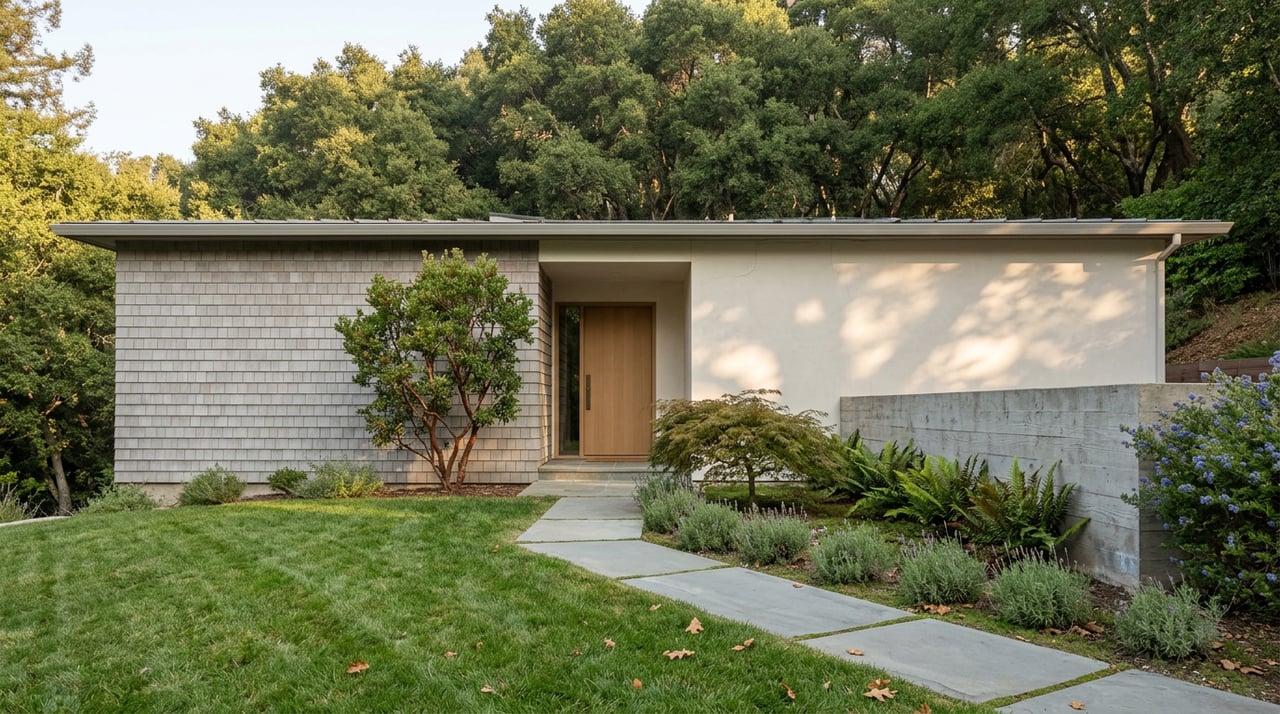
In April, a glass and steel house on Jackson Street came on the market asking $22.5 million. The Perry House sits on a double lot in Pacific Heights, designed in 2002 as an earthquake resistant counterpoint to the Victorians around it, with a view of Alta Plaza Park and the bay beyond. Its owners had assembled the site over more than a decade before building there. It is, by any measure, a singular property.
Across town on Nob Hill, the same season looked much quieter. Not a worse one. A structurally different one.
Buyers who cross-shop these two hills tend to treat them as interchangeable shades of San Francisco prestige, the kind of decision that comes down to taste rather than mechanics. That framing misses the more useful fact. Pacific Heights and Nob Hill are not two versions of the same market. They are two different markets that happen to share a skyline.
The Trophy Market on One Hill
San Francisco's MLS reporting splits the city into numbered districts, and Pacific Heights falls into District 7B. Closed sales data through mid July 2026 show that district producing four of the five largest home sales in the city so far this year. The fifth, a $24 million closing on Larkin Street, belonged to Russian Hill instead, described in that same report as the lone outlier in an otherwise Pacific Heights dominated list.
That concentration is the point. Pacific Heights is built almost entirely on large, low-density lots with formal gardens and, in some cases, carriage houses. Turnover is rare, and when a property does trade, it tends to be large enough to move the district's whole average.
Zillow's tracked value for the neighborhood puts the average home worth at just over $2 million as of the end of June 2026, up 14.3 percent over the prior year. That single number hides more than it reveals. Condominiums inside converted period buildings, the neighborhood's most accessible entry point, start closer to $2 million on their own. Single-family homes begin nearer $5 million. Estates along Broadway and Vallejo, the addresses with unobstructed views toward the Golden Gate Bridge and Alcatraz, routinely clear $20 million, with a handful pushing past $30 million. A blended average across that range tells you almost nothing about what any specific buyer will pay.
The Calmer Market Next Door
Nob Hill sits inside a different MLS bracket entirely, District 8, grouped with Russian Hill, Telegraph Hill, North Beach, and the Financial District. The same district report found that nine of the city's ten residential districts posted a majority of over-list closings through the spring selling season. District 8 was the exception, splitting close to evenly between sales that closed above list and sales that closed below it.
The reason traces back to what's actually for sale. Nob Hill's housing stock is dominated by pre-war high-rise condominiums, cooperative apartments, and tenancy-in-common units rather than detached houses. Buildings like these produce a steady stream of comparable units rather than one-off estates, which tends to keep negotiations calmer and more evenly matched between buyer and seller. As of February 2026, the median Nob Hill sale closed at $1.2 million, with price per square foot near $962, and homes were taking 63 days to sell on average compared to 70 days the year before. Those are not numbers from a market that's cooling. They're numbers from a market that trades in volume rather than in singular events.
That volume shows up in daily life too. The cable car line runs past Grace Cathedral and Huntington Park on its way over the hill. The historic hotel row of the Fairmont, Mark Hopkins, and InterContinental anchors the neighborhood's identity the way Alta Plaza and Lafayette Park anchor Pacific Heights, just built for density instead of estates.
| Pacific Heights | Nob Hill | |
|---|---|---|
| Dominant product | Detached single-family homes, some period condo conversions | High-rise condos, co-ops, and TICs |
| Typical entry point | Condos from roughly $2M; single-family from roughly $5M | Median sale near $1.2M (Feb. 2026) |
| Recent market behavior | Four of the city's five largest 2026 sales landed here | District split evenly between over- and under-list closings this spring |
| Signature draw | Alta Plaza and Lafayette Park, Broadway and Vallejo estate row | Cable car line, Grace Cathedral, historic hotel row |
What's Actually Driving the Gap
The city-wide numbers underneath both neighborhoods explain why they're moving at different speeds. Single-family home prices across San Francisco hit a median of $2,128,000 in June 2026, up 24.8 percent from a year earlier. Condominiums over the same month closed at a median of $1,225,000, up a comparatively modest 6 percent. That gap in appreciation rates is the real mechanism at work. Pacific Heights, built almost entirely on single-family stock, rides the faster half of that split. Nob Hill, built almost entirely on condo and co-op stock, rides the steadier half.
The overbidding data tells the same story from a different angle. Forty-four San Francisco homes closed at least $1 million over their asking price in June 2026 alone, and the average home that month sold for 125.2 percent of its list price. That kind of intensity concentrates where the inventory is scarce and singular, which is exactly the description of Pacific Heights' trophy stock. It is not the description of a district that just split evenly between over- and under-list closings.
What This Means If You're Choosing Between the Two
Neither hill is the better buy in the abstract. They serve different priorities.
A buyer set on single-family scale, a private garden, and the willingness to compete hard for one of a genuinely small number of comparable estates each year belongs in Pacific Heights. That buyer should expect the process to look more like an auction than a negotiation, because four of the five biggest sales in the city this year landed in this one neighborhood.
A buyer who wants walkable, cable-car-served density, a calmer negotiating table, and a deep pool of comparable units to price against belongs on Nob Hill. The slower days-on-market figure and the even split between over- and under-list closings aren't signs of a soft market. They're signs of a liquid one, where buyers and sellers have enough recent, similar sales to actually agree on value instead of guessing at it.
FAQ
Is Nob Hill actually cheaper than Pacific Heights? Product for product, the gap narrows. Pacific Heights' converted period condos start around the same $2 million mark where Nob Hill's median sale sits, once you account for the size difference typical of each building type. The real separation appears in single-family homes, where Pacific Heights starts around $5 million and Nob Hill has almost no detached-house inventory to compare against.
Why did Nob Hill's district trade so much calmer than Pacific Heights this spring? Because it's a deeper market with more recent, similar comparables. A tower full of condos generates dozens of data points a buyer's agent can point to. A double-lot estate on Jackson Street generates one.
Does a longer time on market in Nob Hill mean it's a better time to buy there? It means there's more room to negotiate against real comparables, not that the neighborhood is discounted. A 63-day sale in a condo-heavy district reflects normal absorption of deep inventory, not weak demand.
If you're weighing a move to either hill, or trying to figure out what a specific budget actually buys once you look past the median, that's the kind of analysis worth walking through before you write an offer. Omari Williams combines a private banking background with hands-on San Francisco and Marin experience to help buyers read a market correctly before they compete in it. You can review current conditions on the Nob Hill and Pacific Heights neighborhood pages, or book an appointment to talk through which hill actually fits your budget and your priorities.